
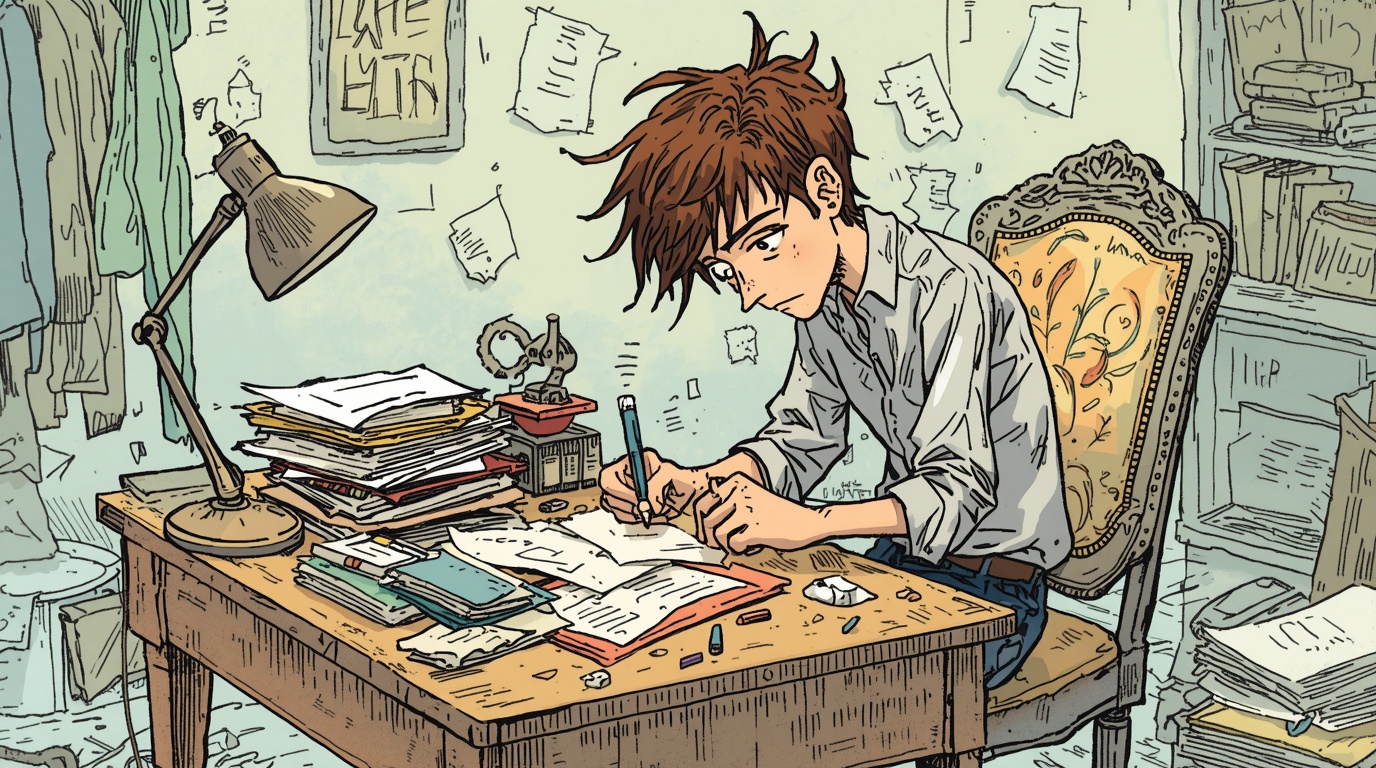
Let me start with a confession: I like to think of myself as a rational man. Methodical, cold-blooded in my decision-making, and generally suspicious of anything that sounds like it was dreamt up during a drum circle at a retreat in Sedona.
So, naturally, against my better judgement I decided to try The Artist’s Way by Julia Cameron.
For the uninitiated, Julia Cameron is the high priestess of “creative recovery.” She claims to have rows upon rows of journals spanning twelve years—thousands of pages that she says provide her with “consolation, advice, humor, and sanity.” Essentially, she treats her notebooks like a therapist who doesn’t charge by the hour.
The crown jewel of her program is the “Morning Pages.” The premise is simple: every single morning, before you do anything else, you write three pages of longhand, stream-of-consciousness drivel. No editing. No filtering. Just a raw dump of your subconscious onto paper. It’s supposed to be a “portable writing room” where you can discover your fears, aspirations, and the “daily flow” of your life.
Sounds great on paper, right? Well, as I discovered, things are rarely that simple when you actually have to buy the paper.
The Logistics of Spiritual Awakening
First off, let’s talk about the hidden costs of creativity. I went into this thinking I was embarking on a spiritual journey; I didn’t realize I was entering a long-term financial commitment to the stationery industry.
I headed to the market to buy notebooks and pens, only to realize that paper isn’t exactly cheap these days. Suddenly, I wasn’t just “uncovering my spirit”—I was calculating how many notebooks I’d need to survive a month without going bankrupt. I ended up buying bulk packs of pens because, as it turns out, writing three pages of manual labor every morning consumes ink at an alarming rate.
I figured, why not? If this makes me a better writer and a better human, it’s worth the investment. I thought I could kill two birds with one pen. (See what I did there? I’m still trying to be a “better writer.”)
The War of the White Pages
Then came the actual act of writing.
I am a man of the digital age. My fingers are accustomed to the rhythmic click-clack of a keyboard, not the friction of a ballpoint pen on a page. For the first few days, I’ll admit it: I was struggling. I didn’t hit three pages. I barely hit one.
And these weren’t small, dainty diary pages; they were massive sheets of paper. Filling them felt like running a marathon with my wrist. I realized very quickly that I am terribly out of shape in the “handwriting” department. If you haven’t written by hand since the late nineties, your forearm will start screaming at you around page two.
But here is where the “male brain” kicked in. Instead of seeing this as an artistic endeavor or a journey of self-discovery, I saw it as a challenge. I viewed the blank white pages as an enemy. It became a war. I told myself that if I could just push through 90 days, I would have “won” against my own laziness and physical limitations.
By the second month, I had actually built up a tolerance. My fingers had habituated to the grind, and I could knock out two long pages without fatigue. I was winning the war. But as any seasoned general will tell you, winning a war is pointless if the territory you’ve captured is a wasteland.
The “Garbage” Realization
Around the three-month mark, things started to get weird. For a while, it felt productive. I was venting; I was writing about what happened yesterday; I was clearing the cobwebs. But by month four, a cold realization hit me: I am writing an enormous amount of absolute garbage.
The goal of Morning Pages is “creative freedom,” but I discovered that freeing your creativity without any structure just produces a mountain of junk. I spent my mornings documenting the mundane details of a Tuesday. I wrote pages upon pages of thoughts that were, in retrospect, completely irrelevant.
Here was the problem: I had no desire to ever read this stuff again.
The idea is that these journals are companions for life. But who wants to reflect on what they felt during a particularly boring breakfast three months ago? The volume of writing became overwhelming. I wasn’t discovering my “inner spirit”; I was just creating a massive archive of pointless observations. It started to feel like I was filling pages just for the sake of filling them.
The “Woo-Woo” Factor and the Privilege Gap
As I continued, I started noticing why some people absolutely hate this book while others treat it like the Bible. If you browse Reddit or any creative forum, you’ll see a divide.
On one side, you have the “Life-Changing” crowd who swear by the “Creator” and the spiritual energy of the process. On the other, you have the skeptics who find the whole thing a bit too “woo-woo.” For a guy like me—methodical and analytical—the spiritual language can be a hurdle. Unless you’re willing to engage in a total suspension of disbelief (or just skip the paragraphs about God providing your finances), it can feel a bit fluffy.
Then there’s the issue of privilege. Julia Cameron suggests things that assume a certain level of financial and temporal freedom. The idea that money is “never” a barrier to creativity because the universe provides is a lovely sentiment, but it doesn’t exactly hold up when you’re staring at your bank account and wondering why you spent fifty dollars on notebooks just to write about how much you hate your commute.
My Pivot: From Stream-of-Consciousness to Data
After six months of this, I stopped. Not because I failed, but because I realized the tool didn’t fit the user.
I am not an “emotional venter.” I don’t have a backlog of repressed feelings that need to be purged onto paper every morning at 6:00 AM. My mind doesn’t need “clearing” in the way Cameron describes; if I need to clear my head, I’d rather take a walk or stare at the sky for ten minutes than write three pages of nonsense.
So, I pivoted. I stopped writing garbage and started using bullet points.
Instead of forcing myself to fill a page, I jot down a few key things I need to remember or analyze. If something actually warrants elaboration, I write about it because it’s important, not because I have a quota to meet. I stopped feeling guilty about not “emptying my soul,” and I stopped wasting money on ink.
I realized that for someone like me, creativity doesn’t come from a raw dump of emotions; it comes from taking data—the facts of the day, the observations of the world—and turning those facts into a story. You don’t need to fill ten thousand pages of a notebook to be creative.
The Verdict: Should You Do It?
So, is The Artist’s Way snake oil? Not necessarily. But it depends on who you are.
You should try Morning Pages if:
- You are highly emotional and feel like you have a “clog” in your mental pipes.
- You need a safe place to vent without judgment.
- You enjoy the tactile feeling of pen on paper and don’t mind spending a small fortune on stationery.
- You aren’t bothered by a bit of New Age spirituality.
You should stay away (or modify it) if:
- You are methodical, analytical, or “cold-blooded.”
- The thought of writing three pages of nothingness makes you want to scream.
- You prefer data over “vibes.”
- You have a limited attention span and hate redundancy.
In the end, Morning Pages taught me something valuable: not every “proven” system works for every person. I didn’t find my soul in those notebooks, but I did find out that I’m much more productive when I stop trying to force myself into a mold that doesn’t fit.
If you want to be creative, just go create something. You don’t need to win a war against blank paper first.