
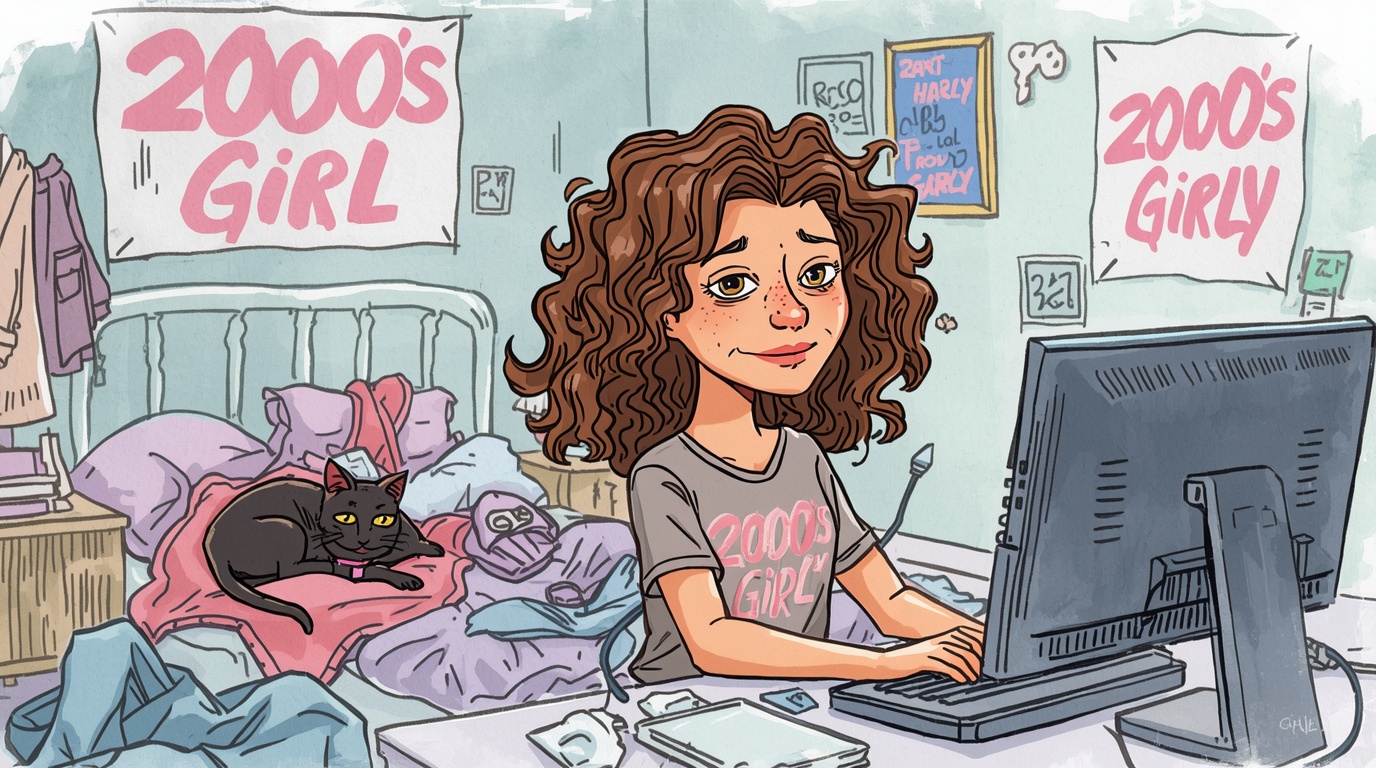
Do you ever find yourself staring at your smartphone screen, feeling a strange, hollow sense of exhaustion? You open an app for one specific purpose—perhaps to check a recipe or message a friend—and suddenly, forty-five minutes have vanished. You’ve been swept away by a current of endless scrolling, loud, fragmented videos, and targeted advertisements for products you didn’t know you wanted, but which the algorithm has decided you need.
Lately, I have found myself longing for a version of the digital world that feels more human. I find myself daydreaming about a time when the internet was not a marketplace or a surveillance tool, but a destination. If we peel back the layers of modern algorithms and corporate influence, we find that the web wasn’t always this noisy. In fact, it started as something quite beautiful, quiet, and profoundly curious.
The Romance of the Early Web
To understand what we have lost, we must look back at where we began. There is a certain romanticism to the early internet—a digital frontier that felt like a shared secret. In its infancy, the web was an academic sanctuary, created by universities as a way to exchange knowledge across borders. It was a space for scholars and dreamers, designed with a singular purpose: the democratization of information.
By the 1990s, this evolved into the era of bulletin boards, forums, and “ezines.” This was the golden age of the text file. People didn’t have “profiles” or “personal brands”; they had interests. They wrote small, thoughtful pieces of text to share their theories on astronomy, their love for obscure poetry, or their tips for a niche hobby. The magic lay in its anonymity. You weren’t performing for an audience or curated for a feed; you were simply a voice in the dark, contributing to a global library of human thought.
I find myself longing for the aesthetic simplicity of that era. I miss the days of basic HTML pages—those charmingly clunky sites with white backgrounds and blue hyperlinks. There was a tactile quality to those pages, perhaps with a sprinkle of CSS that added a touch of color or a quirky font. They weren’t designed by a committee of UX experts to maximize “user retention”; they were built by individuals who simply wanted to tell the world something.
There was a beauty in the slow delivery of content. You didn’t have an infinite scroll; you had pages. You clicked “Next,” and you waited. There was a deliberate pace to discovery. Finding a niche forum felt like discovering a hidden café in a foreign city—a place where people gathered not because they were pushed there by an algorithm, but because they shared a genuine passion.
As we moved into the mid-2000s, this spirit of sharing expanded visually. The advent of YouTube brought a new wave of generosity. We saw the rise of educators like Sal Khan, who turned the screen into a chalkboard, making complex concepts accessible to anyone with an internet connection. Knowledge was exploding, and it felt like we were on the precipice of a global enlightenment.
The Great Commodification
So, where did the silence go? When did the library become a shopping mall?
The shift happened when the internet stopped being about sharing and started being about connecting. While “connection” sounds lovely in theory, it became the Trojan horse for corporate greed. Social media was marketed as a way to bring us closer, but it quickly evolved into a sophisticated money-making machine. The goal shifted from facilitating human interaction to maximizing “engagement”—a clinical term for addiction.
The most heartbreaking part of this transition is the loss of privacy. In the early days, your identity was yours to guard or reveal as you wished. Today, we live in an era of constant surveillance. We have been conditioned to believe that giving up our personal data is simply the “cost” of entry. If you refuse to join a platform, you are socially sidelined; if you do join, you are tracked.
I bemoan the modern invasiveness of the web. Every single click is now monitored by cookies that follow us from site to site like digital ghosts. We are haunted by advertisements for shoes we mentioned in a private conversation or hotels we looked at once three weeks ago. The seamlessness of JavaScript-based advertising has turned the act of reading an article into a minefield; you try to click a link, but a pop-up intercepts you, or a video starts playing loudly in the corner of your screen, demanding your attention.
Our data is no longer ours; it is a product bought and sold by corporations that view us not as people, but as “user demographics.” We have traded our intimacy for convenience, and in doing so, we have allowed the internet to be dominated by a handful of monolithic corporations. The small, quirky websites—the digital gardens where creativity flourished—have largely died off, unmourned by a population too busy filming reels or scrolling through TikToks to notice they are missing.
The Age of Artificiality
As if the loss of privacy and depth weren’t enough, we have now entered the era of AI. While AI offers incredible potential, it has introduced a new crisis: the outsourcing of thought. We are increasingly allowing machines to think on our behalf. We spend hours chatting with bots, accepting their hallucinations as fact without verification or critical scrutiny.
We have reached a point where “content” has replaced “knowledge.” Content is industrial; it is produced at scale, optimized for clicks, and stripped of nuance. We no longer write essays to explore an idea; we write captions to fit a character limit. We no longer read critical pieces that challenge our worldview; we consume snippets of misinformation that confirm our biases.
A Plea for the Decentralized Future
What if we could go back? Not literally—we cannot erase thirty years of progress—but what if we could revert to the spirit of the early internet?
I believe we need a digital renaissance. We need to move toward a more decentralized web, where the power is stripped from the few and returned to the many. Imagine an internet where you own your data, where your attention isn’t a commodity to be auctioned off to the highest bidder, and where the goal of a website is to inform rather than to addict.
We must remember that we are not machines designed to generate content at an industrial scale. Our lives—our quiet mornings, our failures, our slow realizations—are not “content.” They are experiences.
I challenge you to reclaim your digital autonomy. Seek out the long-form essay over the short-form clip. Find a blog written by a human being with a passion, rather than an AI optimized for SEO. Turn off the notifications that demand your attention and rediscover the joy of being unreachable.
Let us stop scrolling through the curated lives of strangers and start seeking knowledge once again. Let us trade the noise of the algorithm for the silence of a thoughtful page. The early internet was a place of wonder, curiosity, and genuine human connection. It is time we stopped settling for the machine and started demanding the soul back.