Why I am trading my Tabs for ink
Let’s be honest: we are all living in a state of digital saturation. Between the endless pings of Slack, the seductive pull of Instagram reels, and the sheer anxiety of having forty-seven browser tabs open at once, our brains feel like they’ve been put through a blender on the “high” setting.
For years, we were told that “going paperless” was the ultimate goal. We bought the sleekest tablets, subscribed to the most promising productivity apps, and convinced ourselves that a cloud-synced ecosystem was the only way to keep our lives organized. But lately, I’ve been feeling a strange tug toward something analog. Something tactile. Something that doesn’t require a software update or a monthly subscription fee just to exist.
I’m talking about the pen and the notebook.
Now, before you roll your eyes and tell me that “analog is for hipsters in coffee shops,” hear me out. Returning to pen and paper isn’t about rejecting technology—it’s about reclaiming our headspace. It’s about realizing that while a keyboard is great for output, a notebook is superior for thinking.
The Privacy Paradox: Who Is Actually Reading Your Notes?
Let’s start with the elephant in the room: privacy. We’ve reached a point where we treat “Terms and Conditions” like a formality—we just scroll to the bottom and click “Agree” without a second thought. But have you ever stopped to think about where your digital thoughts actually live?
When you jot down a fleeting idea, a private worry, or a secret dream in a cloud-based app, that information isn’t just “sitting there.” It’s being processed. Somewhere, in a server farm in the middle of a desert, an algorithm is analyzing your patterns. Your private musings are essentially data points.
The beauty of a physical notebook is its absolute, blissful silence. A Moleskine doesn’t track your location. A spiral-bound notepad doesn’t sell your “interest in fountain pens” to third-party advertisers so they can bombard you with ads for ink refills on Facebook. When you write on paper, the conversation is strictly between you and the page. There is a profound sense of psychological safety that comes from knowing that no company is monitoring your activity or mining your subconscious for marketing gold. Your private information stays exactly where it belongs: in your hands.
The “Subscription Fatigue” is Real
Then there’s the cost. We live in the era of the “Subscription Economy.” It feels like everything now requires a monthly tribute to some Silicon Valley overlord. You want the pro version of your notes app? $4.99 a month. You want more storage for your PDFs? Another $2.99.
Individually, these amounts seem trivial. But collectively? They are “death by a thousand cuts” for your savings account. We’ve shifted from owning our tools to renting them.
The most liberating part of returning to paper is the ownership. When you buy a notebook and a pen, you own them. Period. No one can block your access to your thoughts because your credit card expired. There is no “server outage” that prevents you from accessing your to-do list. You are the sole administrator of your archives. In a world where our digital lives are essentially leased, there is something incredibly grounding about owning a physical object that holds your history.
The Art of Slowing Down (and the Joy of Mindfulness)
Now, let’s talk about the feeling of it. There is a specific kind of mindfulness that happens when you put pen to paper—a rhythm that digital typing simply cannot replicate.
When we type, we are fast. Too fast, perhaps. We can delete a sentence as quickly as we think it, which means we often don’t actually think about the sentence before we commit it to the screen. Typing is an act of erasure; writing is an act of commitment.
When you write by hand, you become acutely aware of your grammar, your phrasing, and the weight of your words. Why? Because ink is permanent (or at least, a lot harder to erase than a digital character). There’s a subtle, subconscious pressure not to waste the page or ruin the flow with sloppy mistakes. This forces us to slow down. It forces us to be intentional.
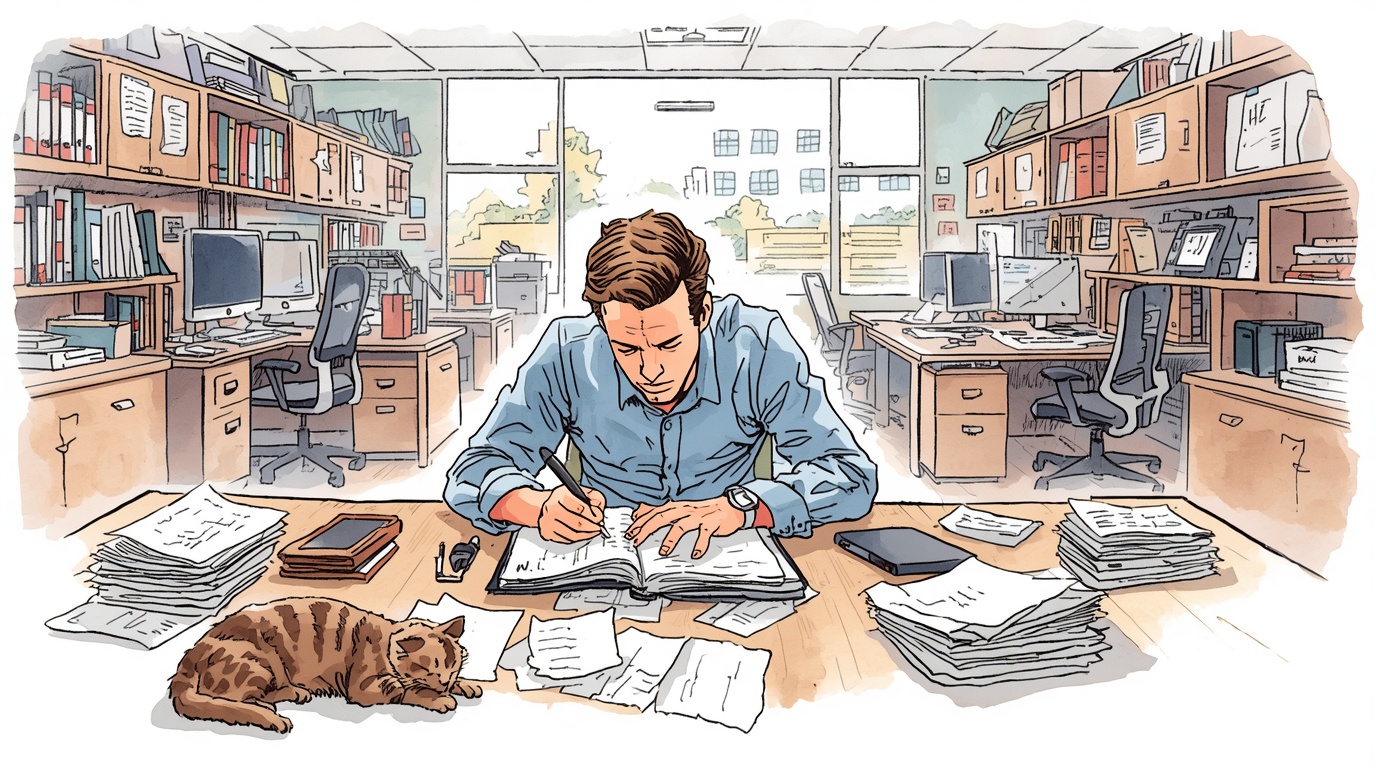
In a world that prizes speed above all else, slowing down is a radical act. Writing by hand turns a chaotic brain-dump into a curated experience. You aren’t just recording information; you are processing it in real-time. There is a meditative quality to the scratch of a nib on paper that acts as a signal to the brain: Stop rushing. Be here. Focus.
The Science of the Scribble: What’s Happening in Your Head?
If the “vibe” isn’t enough to convince you, let’s look at the hard science. I recently came across some fascinating research (shout out to Scientific American and the Norwegian University of Science and Technology) that explains why our brains love handwriting.
Here is the gist: typing is a repetitive motion. Whether you are typing an ‘A’ or a ‘Z’, your finger does essentially the same thing—it pushes a button. It’s efficient, sure, but it’s cognitively “shallow.”
Handwriting, however, is a full-body experience for the brain. To produce a letter by hand, you have to engage your fine motor system. Your brain has to coordinate vision, sensory processing, and movement all at once. According to researcher Audrey van der Meer, this creates distinct neural pathways that typing simply doesn’t touch.
When we type, information often flows from our ears or eyes straight to our fingertips without ever stopping in the “deep processing” center of the brain. It’s like a conveyor belt. But handwriting forces us to prioritize content. Because you can’t write as fast as people speak (or as fast as you think), your brain has to actively consolidate new information, filtering out the noise and keeping the essence.
This isn’t just for adults, either. For children, this is practically a superpower. Research from Vanderbilt University shows that handwriting locks motor and sensory systems together, which is crucial for early literacy. It helps kids distinguish between mirror-image letters like ‘b’ and ‘d’—something that can be surprisingly tricky when you’re only tapping on a glass screen. By materializing an idea from the imagination onto paper, children reinforce memory pathways that are far more durable than those created by digital interfaces.
The Danger of “Cognitive Offloading”
This brings us to a scary little concept called “cognitive offloading.” This is essentially the act of letting our devices do the heavy lifting for our brains.
We don’t remember phone numbers anymore because our contacts list does it. We don’t navigate cities because GPS does it. And we don’t synthesize information because we can just “search” for it later. While this efficiency is great for research, over-reliance on it can lead to a deterioration of our memory and motor skills.
If we stop using the parts of our brain responsible for handwriting and deep synthesis, those neural connections weaken. It’s the “use it or lose it” principle. By returning to pen and paper, we are essentially taking our brains to the gym. We are refusing to let a piece of aluminum and glass do all the thinking for us.
How to Transition (Without Going Full Hermit)
Now, I’m not suggesting you throw your MacBook in the trash and move to a cabin in the woods (unless that’s your thing). The goal isn’t to eliminate technology, but to balance it.
The “Cosmopolitan” way to do this is to create a hybrid system. Use your digital tools for what they are best at: scheduling, complex research, and communication. But reserve your notebook for the internal work.
Here are a few ways to start:
- The Morning Brain Dump: Spend ten minutes every morning writing whatever is in your head. No editing, no deleting—just ink on paper. It clears the mental clutter before you open your email.
- The Meeting Notebook: Instead of typing notes during a meeting, try handwriting them. You’ll find that you actually listen better because you aren’t trying to transcribe every word; you’re synthesizing the key points.
- The “Analog Hour”: Set aside one hour a day where all screens are off and only paper is allowed. Use this for planning your next project, journaling, or sketching ideas.
Final Thoughts: The Luxury of the Tangible
At the end of the day, returning to pen and paper is about reclaiming a sense of tangibility in an increasingly virtual world. There is a unique satisfaction in flipping through a notebook from three years ago and seeing not just what you wrote, but how you wrote it. You can see where your handwriting got messy because you were excited; you can see the ink blots where you paused to think.
A digital document is sterile. It looks the same whether you wrote it in a state of panic or a state of peace. But a notebook? A notebook is a map of your mental state over time.
So, do yourself a favor. Go to the store, pick out a notebook that feels good in your hands, and find a pen that glides across the page. Give your brain the workout it deserves, give your privacy some breathing room, and give yourself the luxury of slowing down.
It’s time to come back to the page. Your brain will thank you.
Leave a Reply